
10 Most Populated States in Nigeria: Real Records, Practical Living Guide, Jobs, Business, Costs & Hidden Insights
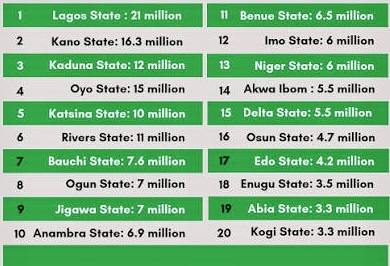
Population in Nigeria is not just numbers on paper. It is pressure, movement, survival, and opportunity all mixed together. Some states are always overflowing with people because of trade, work, farming, or simply the way life pulls everyone toward certain locations.
In reality, when people talk about “big states,” they are not only referring to land size. They are talking about where life is happening the most. Markets are packed, transport never stops moving, rent keeps rising, and businesses rotate daily. That is the real meaning behind population ranking in Nigeria.
The truth is that Nigeria has not conducted a recent full census, so what we rely on are official projections from national records and demographic estimates. These figures still give the clearest picture of how people are distributed across the country.
Official Population Ranking of Nigerian States (Estimated Data)
Below is the most widely accepted structure based on National Bureau of Statistics projections and population growth trends.
| Rank | State | Estimated Population | Key Insight |
|---|---|---|---|
| 1 | Kano | 16M+ | Largest commercial hub in the North |
| 2 | Lagos | 15M+ | Economic capital, fastest urban growth |
| 3 | Katsina | 9M+ | Strong rural and trade population |
| 4 | Kaduna | 8M+ | Military, education, and industry mix |
| 5 | Bauchi | 7M+ | Agriculture-heavy population |
| 6 | Oyo | 7M+ | Ibadan dominance, strong commerce |
| 7 | Anambra | 7M+ | Business-driven Southeast state |
| 8 | Rivers | 7M+ | Oil economy and Port Harcourt influence |
| 9 | Jigawa | 6–7M | Farming and border trade population |
| 10 | Niger | 6–7M | Large landmass with growing settlements |
These numbers are not static. Every year, migration, birth rates, and urban expansion continue to push them higher.
What Makes These States Highly Populated
Population does not happen randomly. There are real reasons behind it:
- Strong business activities (especially Lagos, Kano, Rivers)
- Government presence and job opportunities
- Education hubs (Kaduna, Oyo, Anambra)
- Agriculture and trading routes (Kano, Katsina, Jigawa)
- Oil and industrial economy (Rivers, Lagos)
Lagos attracts people because of money flow. Kano attracts people because of trade strength. Kaduna and Oyo sit in between because they balance cost and opportunity.
Economy, Jobs & Real Income Sources
Each of these states runs on different economic systems.
Lagos
This is Nigeria’s main commercial engine. Jobs in tech, banking, entertainment, logistics, and import/export dominate. Salaries are higher, but the cost of living is also significantly higher.
Kano
Kano is business-driven in a different way. Wholesale markets, leather production, agriculture export, and cross-border trade are the main income sources.
Kaduna & Oyo
These are mixed economies. Government jobs, teaching, small manufacturing, and local businesses dominate daily income flow.
Rivers
The oil economy plays a major role here. Many jobs come from oil companies, construction, and service industries linked to the petroleum sector.
Anambra
One of the strongest private business states in the Southeast. Trading, importation, and distribution networks are very active.
Cost of Living Breakdown (₦ and USD Reality)
Living costs depend heavily on lifestyle and specific location within each state.
Lagos (High Cost Zone)
- Rent: ₦800,000 – ₦1.5M yearly for a basic 1-bedroom
- Monthly living: ₦400,000 – ₦800,000 for a moderate lifestyle
- Transport and food: expensive due to demand
Kano / Kaduna (Lower Cost Zone)
- Rent: ₦300,000 – ₦600,000 yearly
- Monthly living: ₦150,000 – ₦300,000
- Food is cheaper due to local production
Rivers / Oyo / Anambra (Mid Range)
- Rent: ₦400,000 – ₦900,000 yearly
- Monthly living: ₦250,000 – ₦500,000
USD Conversion Reality
With exchange rates around ₦1,400–₦1,500 per $1:
- Low lifestyle: $100 – $300 monthly
- Middle lifestyle: $300 – $700 monthly
- High lifestyle (Lagos level): $800+ monthly
Travel Cost Insight (Local & International)
International Travel to Nigeria
- USA to Nigeria: $900 – $1,700
- UK to Nigeria: $500 – $1,200
- Europe routes: similar to UK range
Local Travel
- Lagos to Abuja: ₦70,000 – ₦150,000 (flight depending on timing)
- Inter-state bus travel: ₦10,000 – ₦40,000 depending on distance
Transport costs rise quickly in highly populated states due to demand pressure.
Hidden Reality of High Population States
High population is not only an advantage; it also brings pressure:
- Traffic congestion (especially Lagos)
- Housing shortages in urban areas
- Higher job competition
- Pressure on healthcare and schools
But at the same time:
- Bigger markets for business
- More daily customers
- Faster business growth potential
- Stronger networking opportunities
It depends on how you position yourself.
Frequently Asked Questions (FAQ)
1. Which state is the most populated in Nigeria?
Kano is officially ranked highest based on current projections, although Lagos is often debated due to urban migration and density.
2. Is Lagos more populated than Kano?
Lagos has higher urban density, but Kano still holds a higher total population in official estimates.
3. Which state is best for business?
Lagos leads for corporate business, Kano for trading, and Anambra for private import/export businesses.
4. Which state has the cheapest cost of living?
Kano, Jigawa, and parts of Kaduna are generally cheaper compared to southern states.
5. Why is population important in Nigeria?
It affects jobs, housing, transport, business growth, and government planning.
Final Insight
Population in Nigeria is more than numbers; it reflects the movement of people chasing survival and opportunity. Some states are overloaded with pressure, while others are quietly growing under the radar. Understanding these differences helps in making smarter decisions, whether for relocation, business, or lifestyle planning.
Every state on this list has its own strength, but how you position yourself within that system matters more than the population itself.





One Comment